
Overview
A unique membrane filtration system can be used for processing Phosphoric Fertilizer products. The system is manufactured by New Logic, of Minden, NV. The VSEP (Vibratory Shear Enhanced Process) system uses a Microfiltration membrane module with special construction for service with high temperature. The use of high temperature vibrating polymeric membranes has significant advantages over the use of Filter Presses and other conventional methods of clarifying phosphoric fertilizers. New Logic’s use of vibrating membranes in its VSEP Filter Pack is groundbreaking and has stirred the interest of the mining community around the world.
Background
Phosphoric Acid is used primarily in the manufacture of fertilizers, detergents, and pharmaceuticals. Phosphorous is one of the elements essential for plant growth. Organic Phosphates are the compounds which provide energy for most of the chemical reactions that occur in living cells. Therefore, enriching soils with Phosphate Fertilizers enhances plant growth. Phosphate mining is concentrated in areas throughout the world. These places include Florida, North Carolina, Wyoming, Idaho, Ontario, Queensland Australia, Morocco, and Jordan.
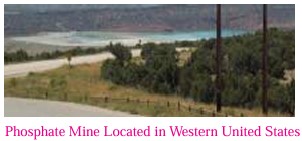
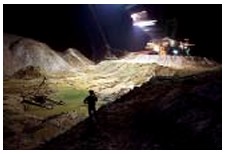
Interestingly, phosphate harvesting is a big industry on the Christmas Islands where birddroppings accumulate in great quantities. Mining in the early part of this century was done by hand using a pick and shovel. Then in 1920, Bill Carey developed the dragline, a mechanized shovel capable of 600 cubic yards per hour. Today’s draglines can weigh up to 3650 tons with a reach of 325 feet.

The process of mining Phosphorous ore involves first removing about 25′ of overburden. The phosphate rock is removed using the dragline and sent to a washer where large clay balls are pulverized and removed. The remainder passes through a shaker screen where sand and phosphate pebbles are recovered. This slurry is sent to a floatation basin where the sand and phosphate are separated. The sand is saved for reclamation, and the phosphate is dewatered and stored in stockpiles. The stored phosphate rock is shipped by rail to the processing plant where it is finely ground to a uniform size and mixed with Sulfuric Acid. The result is Calcium Sulfate and Phosphoric Acid. The Calcium Sulfate (gypsum) is removed by filtration to clarify the Phosphoric Acid. The chemical reaction is as follows:

From here, Phosphoric Acid can be processed into many things including animal feed enhancers and various grades of commercial Phosphoric Acid. The largest use is for fertilizer. In this case the Phosphoric Acid is reacted with Ammonia (a nitrogen source) to make Monoammonium Phosphate (MAP), Diammonium Phosphate (DAP), or Triammonium Phosphate (Liquid Poly-Ammonium Phosphate 10-34-0)
Filtration is used to remove Calcium Sulfate, Silica, Fluoride, and other suspended solids from the initial Phosphoric Acid. Worldwide production of Phosphate rock is as follows:
Vibratory Shear Process
India 7% VSEP’s unique separation technology is based upon an oscillating movement of the membrane surface with respect to the liquid to be filtered. The result is that blinding of the membrane surface due to the buildup of solids is eliminated and free access to the membrane pores is provided to the liquid fraction to be filtered. The shear created from the lateral displacement causes suspended solids and colloidal materials to be repelled and held in suspension above the membrane surface. This combined with laminar flow of the fluid across the membrane surface keeps the filtered liquid homogeneous and allows very high levels of recovery of filtrate from the feed material. The liquid fertilizer can be filtered in a single pass filtration using VSEP. Other methods like filter presses are done in batch mode with operators opening and cleaning the filter cake on a regular basis. VSEP is a continuous automated process requiring very little operator attendance.
Results using VSEP

VSEP’s Microfiltration high temperature membrane module is capable of treating phosphoric compounds and providing a filtrate, which is nearly free from suspended solids. The VSEP process does not involve any chemical addition and meets the criteria of a process engineer’s needs for inline automated production. Both Permeate and Concentrate can be sold as product. VSEP modules containing about 1300 SF (120m2) of filtration media are modular and can be run in parallel as needed to meet any process flow requirements.
Process Description
The Phosphoric Compounds are collected hot and stored in holding tanks. The Phosphate Liquid is pumped into the VSEP system for filtration. The viscosity of the material plays a big part in the rate of filtration. Heat will help to decrease the viscosity of the slurry and therefore, improves the throughput of the VSEP system. Some current VSEP applications are running at about 100ºC. Some experimental runs have been accomplished at temperatures of up to 115ºC. The mechanical design of the VSEP filter module has been recently redesigned to handle temperatures over 120ºC. With very viscous materials it is not uncommon for the throughput to double between 100ºC and 120ºC.
The heated Phosphate is pumped into the VSEP Filter Pack at about 120 psi. The contents of the feed tank are processed so that the filtrate is sent to a “Look See” holding tank and then a larger product storage tank. As filtrate is removed by filtration, the contents of the filter pack are concentrated and volume reduced until the desired % recovery is reached. Each VSEP unit can process about 43,000 gallons per day.
When the permeate rate drops off, the Filter Pack is cleaned using New Logic’s formulated membrane cleaners out of a Clean in Place tank of about 200 gallons. This is done by recirculating the cleaner with pressure and vibration to dissolve foulants that have found their way to the membrane. Months of pilot testing and actual site conditions have shown that the membrane is able to clean up very well and the results from week to week are predictable and stable.
System Components
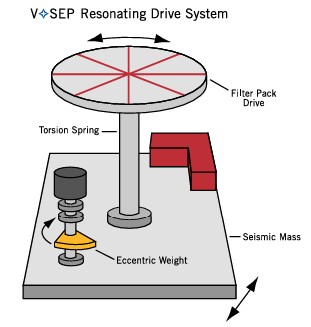
The VSEP system is configurable for manual mode where the operator would initiate operating sequences, or for full automation including seamless cleaning operations with round robin cleaning or multiple units. The VSEP has a PLC (Programmable Logic Controller) which monitors pressure, flow rate, and frequency. It also provides the safety in operation by monitoring conditions and initiating an alarm shut down should some configurable parameters be reached. The controls include the PLC, Operator display, and process instrumentation. The Filter Pack is mounted on the VSEP base unit and contains about 1300 SF, (120m2), of membrane area and is constructed out of high temperature materials.
The VSEP drive system, which supports and vibrates the Filter Pack is engineered using space age alloys and materials to withstand the applied stress from a resonating frequency of about 50 hz. Each base unit is fully stress tested at the factory prior to shipment. The VSEP drive system is made up of the Seismic Mass, Torsion Spring, Eccentric Bearing, and Lower Pressure Plate.
System Throughput
Each of the VSEP modular units for this project are capable of processing up to 43,000 gallons per day. Since the units are modular and can be used in parallel or in series, the number of VSEPs needed can be calculated based on the amount of available material to be processed. System throughput is also a function of the extent to which the feed is concentrated.
Project Economics
Table 1 below shows the operating costs for the installation of one VSEP module as currently configured. The VSEP is uniquely energy efficient. It comes with a 20 HP drive motor and a 10 HP Pump Motor. Operators interface and maintenance is limited to starting and stopping the unit and a periodical cleaning of the membrane after an extended run. The membrane replacement has the largest operating cost, and it is estimated that the life of each module is approximately 2 to 3 years. Operator care can improve the life, and additional savings could be yielded if the Filter Pack lasts more than 2 years.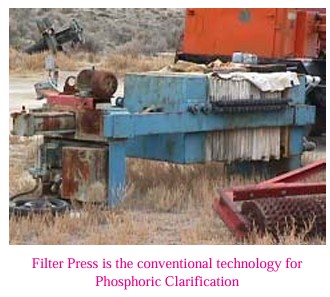
The market for fertilizer and therefore Phosphoric Acid is subject to fluctuation based on supply and demand. The chief parameter for economics analysis of the VSEP process would be the operating cost comparison of the VSEP against conventional methods such as filter presses. The possible uses of the VSEP for Phosphate production are wide ranging including Phosphate Ore Processing, Phosphate Slime removal, slurry water recycling, and reclamation projects.
Other VSEP Mining Applications
Mining and chemical processing applications predominate the possible uses for VSEP:
• Acid Mine Drainage
 • Radioactive Nuclei Removal
• Metals Removal from Wastewater
• Arsenic Removal
• Titanium Dioxide Concentration
• Railcar Wash
• Calcium Carbonate Dewatering
• Product Recovery from Wastewater
• Kaolin and Bentonite Clay Concentration
Company Profile
New Logic has developed a cutting-edge technology for effective membrane filtration and has provided a solution for age-old waste problems as well as new ways for chemical processing. New Logic is a privately held corporation located in Emeryville, CA approximately 10 miles from San Francisco. New Logic markets, engineers, and manufactures a membrane dewatering and filtration systems used for chemical processing, waste streams, pulp & paper processing, mining operations, and drinking water applications. VSEP technology was invented by Dr. Brad Culkin in 1985. Dr. Culkin holds a Ph. D. in Chemical Engineering and was formerly a senior scientist with Dorr Oliver Corporation. VSEP was originally developed as an economic system that would efficiently separate plasma from whole blood. The company received a contract to produce a membrane filtration prototype, which would later be incorporated into a blood analyzer system.
The Series i (Industrial) is a full-scale model and comes in sizes ranging from 100Square Feet to 2000Square Feet. These units are modular and can be used in parallel or in series. Successful VSEP systems are in place now worldwide including Europe, Central Asia, Southeast Asia, Australia, South America, Canada, Mexico, and of course here in the United States. New Logic offers a strong engineering staff to assist customers in the design, development, and testing of their filtration systems.
The plant has extensive equipment and machinery for manufacturing nearly all the VSEP parts. Manufacturing, assembly, and testing of all equipment takes place at this site. Systems and procedures are in place and geared towards high standards of quality control and have met the acceptance criteria of stringent applications such as nuclear waste processing.
For more information about how V✧SEP can help you, please contact us at info@vsep.com.
To keep up with industry news and New Logic Research subscribe to our newsletter below.
To follow New Logic Research on LinkedIn Click Here