
VSEP® Nanofiltration for Kraft Pulp Mills
Unlock Recovery Boiler Capacity with VSEP® Nanofiltration
Reduce Black Liquor Volume • Recover Caustic • Lower Energy Cost
VSEP® Nanofiltration (NF) revolutionizes kraft pulping by separating black liquor into a concentrated lignin stream and a clean caustic NF filtrate, which can be directly recycled to the digester. Mills gain higher throughput, reduced steam consumption, and significantly lower chemical costs – without expanding the recovery boiler by using VSEP for black liquor filtration.
The kraft pulping process depends on an efficient chemical‑recovery cycle. However, as mills push capacity limits, the recovery boiler often becomes the bottleneck. Traditional evaporation and recovery systems must process large volumes of black liquor, driving energy consumption and limiting production throughput.
VSEP® (Vibratory Shear Enhanced Processing) with nanofiltration technology introduces a modern solution: filter black liquor at the source, concentrate the high‑molecular‑weight organics – including lignin – and return the clean NF permeate back to the digester cycle. VSEP NF filtrate recycling can depend on mill sulfidity, TRS content, and compatibility with white liquor makeup
The result: reduced evaporator load, lower energy cost, improved chemical recovery efficiency, and new opportunities for lignin valorization.
How Caustic Recovery Works Today
In a conventional kraft mill, the chemical recovery loop includes:
- Digestion – Wood chips are cooked with white liquor (NaOH + Na₂S). The spent liquor becomes weak black liquor. It contains dissolved lignin, hemicelluloses, inorganics (Na⁺, OH⁻, S-species), extractives
- Multiple‑Effect Evaporators – Black liquor must be evaporated from ~15% solids to 65–80% solids before firing in the recovery boiler. This evaporation step is: energy‑intensive, a major source of steam demand, and often a capacity limiter for the mill
- Recovery Boiler – The concentrated liquor is burned to: recover inorganic smelt (primarily Na₂CO₃ + Na₂S) and to generate steam and power. Recovery boilers are expensive to expand or replace and typically operate near their maximum firing load.
- Causticizing – The smelt is dissolved to green liquor and reacted with lime to regenerate NaOH for the digester.
The Bottleneck Problem
As mills increase production, recovery boilers become the pinch point. Every gallon of black liquor that must be evaporated and burned directly adds:
- Evaporator energy consumption
- Recovery boiler firing load
- Chemical recovery cycle stress
This constrains mill throughput and raises operational cost.
How VSEP® Nanofiltration Transforms Black Liquor Processing
- Filters Black Liquor at the Source
VSEP with a 300 Da pH tolerant nanofiltration separates black liquor into:
- Concentrated Retentate
-
- Lignin
- Long‑chain polysaccharides
- Extractives
- Other high‑molecular‑weight organics
This reduced‑volume concentrate can be sent to:
-
- The evaporator
- Lignin recovery / bio‑products
- Combustion processes
- NF Filtrate – Low‑viscosity permeate containing:
-
- Recovered caustic (NaOH)
- Sodium salts (Na2CO3, Na2S)
- Low‑MW organics
This filtrate can be directly recycled to the digester, reducing fresh caustic consumption.
- Reduces Recovery Boiler Load
By removing water and caustic upstream:
- concentrated black liquor solids are sent to the evaporators and recovery boiler.
- Steam demand drops.
- Boiler capacity is freed up, enabling increased pulp production without capital expansion.
Mills constrained by boiler load often see this as the #1 value driver of the VSEP installation. The recovery boiler often becomes the bottleneck in kraft mill expansion efforts, limiting the ultimate level of pulp production and mill profit
- Direct Caustic Reuse
Because molecular‑weight cutoffs reject large organics, the permeate is clean enough to reuse as process liquor in:
- The digester
- Oxygen delignification
- Brown‑stock washing
This reduces:
- Fresh caustic purchases
- Load on the recausticizing plant
- Lime kiln energy consumption
- Lignin Concentration Creates New Value Streams
The VSEP concentrate contains elevated lignin, enabling:
- Lignin‑based chemical feedstocks
- Adhesives
- Carbon fiber precursors
- Bio‑polymers
- Fuel pellets
Many mills are deploying VSEP specifically as a pre‑treatment step for lignin extraction. NF is used when the lignin will be evaporated and sent to the recovery boiler. UF can be used if lignin recovery is desired for purification and sale.
Key Benefits
- Reduce black liquor volume to the evaporators and recovery boiler
- Recycle NF filtrate to the digester—recover NaOH and reduce chemical cost
- Concentrate lignin for value‑added products
- Lower steam usage and energy cost
- Improve overall mill efficiency without major capital projects
VSEP® is the most advanced membrane system for black liquor filtration due to its vibratory shear technology, which minimizes fouling and handles extremely high‑solids, high‑viscosity streams. The VSEP also employs a rugged high pH tolerant membrane.
Value From Byproducts: Lignin, Biopolymers, and Syngas
Modern kraft mills are increasingly looking beyond traditional pulp production to capture the enormous economic value locked inside black liquor. By concentrating high‑molecular‑weight organics with VSEP® Nanofiltration, mills can tap into three major byproduct revenue and efficiency opportunities: lignin recovery, biopolymer production, and syngas generation.
- Lignin Recovery — A High‑Value Industrial Feedstock
Lignin makes up nearly 30% of wood and is the largest renewable aromatic polymer on Earth. In the kraft process, it ends up dissolved in black liquor—yet most mills burn it solely for energy. VSEP concentrates lignin into a dense retentate stream, dramatically improving the economics of downstream lignin extraction technologies.
Value Opportunities:
- Bio‑based adhesives and resins – Lignin substitutes phenol in phenol‑formaldehyde resins used for plywood, laminates, and coatings.
- Carbon fiber precursors – Lignin’s aromatic structure makes it a promising low‑cost carbon fiber feedstock.
- Biochemicals – Lignin-derived aromatics such as vanillin, BTX, and other specialty chemicals have high market value.
- Solid fuels or pellets – Concentrated lignin provides higher energy density and cleaner combustion than raw black liquor.
Why VSEP improves lignin recovery:
VSEP® can concentrate the lignins using ultrafiltration up to 45%. Unwanted salts and dissolved solids are removed into the filtrate. Additional washing steps can be used to remove more unwanted materials and make a more pure lignin product for sale.
- Biopolymer Recovery – Hemicelluloses and Extractives
Black liquor contains not only lignin but also hemicelluloses, extractives, and long‑chain carbohydrates, which can be recovered for specialty applications.
Value Opportunities:
- Bio‑based polymers and films – Hemicelluloses can be converted into biodegradable packaging materials.
- Hydrogels and specialty binders – Used in agriculture, food products, and cosmetics.
- Precursor sugars for fermentation – These can feed biorefineries producing biofuels, organic acids, and bioplastics (such as PHA or PLA precursors).
Why VSEP enables this:
NF membranes selectively retain these high‑molecular‑weight biopolymers while allowing cooking chemicals to pass through into the digester filtrate. The result is a clean, concentrated stream ready for valorization.
- Syngas Production — Gasification of Concentrated Organics
The organic fraction of black liquor—especially lignin—can be gasified to produce syngas (CO + H₂), a versatile feedstock that can be upgraded into multiple energy and chemical products.
Value Opportunities:
- Renewable fuels – Syngas can be converted into methanol, ethanol, Fischer–Tropsch liquids, or hydrogen.
- Process heat and power – Higher conversion efficiency compared to direct combustion in the recovery boiler.
- Chemical intermediates – Syngas can feed the production of ammonia, synthetic natural gas, or olefins.
Why VSEP helps:
Gasification systems perform best with high-solids, low-ash, low-alkali feeds. VSEP reduces water and isolates the organics, significantly improving gasifier stability, throughput, and thermal efficiency.
How VSEP® Works – Why It Excels in Black Liquor Filtration
VSEP® (Vibratory Shear Enhanced Processing) uses a unique vibratory motion to keep membranes clean while processing extremely high‑solids, high‑viscosity streams like kraft black liquor. Instead of relying on high crossflow velocity like conventional membrane systems, VSEP oscillates the membrane surface at high frequency. This vibration creates intense shear at the membrane interface, preventing fouling and enabling sustained high flux even with challenging feedstocks.
In operation, black liquor enters the VSEP module with nanofiltration membranes that separate the stream by molecular size. Large organic molecules—such as lignin, extractives, and long‑chain polysaccharides—are retained and concentrated, while valuable low‑molecular‑weight constituents, including sodium hydroxide and other inorganic cooking chemicals, pass through as NF filtrate. This filtrate is clean enough for direct recycle to the digester, lowering both chemical makeup requirements and recovery cycle loading.
The NF filtrate will contain sulfide, thiosulfate, and polysulfides. Sulfidity levels should be monitored once recycled NF filtrate is blended with white liquor makeup.
Membrane Operating Ranges
- NF membranes with 150-300 da MWCO
- NF pH tolerance 0-14, Temperature tolerance <70ºC
- Typical flux rates: 20-50 GFD
Case Study #1 – Wood Pulp – Manchester England
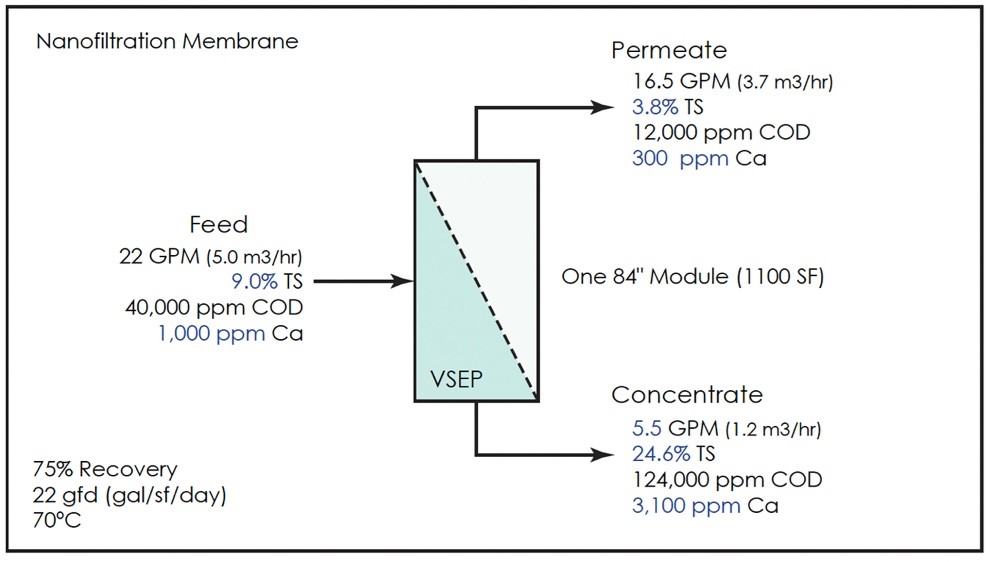
In 1999, New Logic installed a VSEP NF system at a specialty pulp mill in Manchester, England. This plant did not have a caustic recovery process and was sewering the weak black liquor. The VSEP system was able to filter the effluent to recycle caustic water and to concentrate the lignin where it was recovered and sold as a value-added product. The system recovered 75% of the volume as clean caustic water for reuse. The NF membrane concentrated the total solids from 9% to 24%.
Case Study #2 – Straw Pulp, University of Washington.
Dr. William McKean of University of Washington conducted research using VSEP NF to turn waste straw into a more profitable and efficient venture for non-wood paper production. Using the VSEP technology, lignin was extracted from the black liquor during straw pulp processing and converted into biomass for use in energy production. Caustic NF filtrate was recovered to be reused. Samples from this black liquor filtration are shown here:

Case Study #3 – Bagasse Pulp, Southeast U.S.
In 2000, New Logic installed a VSEP NF system to treat 200 gpm (50 m3/hr) of spent liquor from pulping of sugarcane bagasse. The system recovered 85% of the volume as a caustic water filtrate that was recycled. The remaining concentrate (15%) was evaporated. The system achieved an average flux rate of 35 GFD (gallons per square foot per day).

Pilot Testing Program
New Logic offers pilot testing, including full‑scale demonstrations, to evaluate VSEP treatment performance for specific black liquor applications. This is especially important for mills with unusual liquor chemistry.
Pilot testing allows:
- Verification of separation quality
- Measurement of flux, recovery, and fouling behavior
- Mass balance calculations
- CIP frequency ranges
- Accurate operating cost projections
- Optimization for reuse or ZLD configurations
Get a Site‑Specific Cost Analysis
Every pulp mill is chemically unique. VSEP works for not only wood pulping liquor, but also agricultural waste pulping from wheat straw and sugar cane bagasse. All of our projects are treated confidentially. New Logic can provide an accurate performance and cost evaluation for your specific project.
Work directly with an experienced VSEP engineer to model your treatment system:
info@vsep.com
+1‑775‑783‑7600
Learn More
- VSEP® Technology Overview
https://www.vsep.com/technology/ - Pilot Testing Programs
https://www.vsep.com/technology/pilot-testing/
FAQ: VSEP® Nanofiltration for Black Liquor Filtration & Recovery Boiler Optimization
1. What problem does VSEP® Nanofiltration solve in kraft pulp mills?
VSEP® NF reduces the volume of black liquor that must pass through the evaporators and recovery boiler. This helps mills eliminate their most common production bottleneck – boiler firing capacity – enabling increased pulp throughput without major capital expansion.
2. How does nanofiltration reduce recovery boiler load?
NF removes water and passes sodium‑rich permeate upstream, sending a smaller, more concentrated solids stream to the evaporators and boiler. By reducing incoming liquor volume, the boiler sees lower firing load and reduced steam demand.
3. Can NF filtrate be reused directly in the digester?
Yes. NF filtrate contains sodium values (NaOH, Na₂CO₃, Na₂S) and low‑molecular‑weight organics suitable for reuse in the digester, oxygen delignification, or brownstock washing. Mills should monitor sulfidity when blending filtrate with white liquor makeup.
4. Does VSEP handle high‑solids, high‑viscosity black liquor?
Yes. Unlike conventional crossflow membranes, VSEP uses vibratory shear to prevent fouling, allowing stable flux even with high‑viscosity, high‑solids black liquor streams that traditional systems cannot process making black liquor filtration viable for VSEP.
5. What molecular weight cutoff (MWCO) does VSEP NF use for black liquor filtration?
Typical NF membranes operate in the 150–300 Da MWCO range, which allows inorganic cooking chemicals to pass through while retaining lignin, hemicelluloses, and other high‑MW organics.
6. Can VSEP concentrate lignin for value‑added applications?
Yes. VSEP concentrates lignin and other organics into a dense retentate stream suitable for lignin extraction, biopolymer production, carbon‑fiber precursors, or fuel pellet manufacturing. Mills can use NF when the concentrate will go to the boiler, or UF when lignin purification is desired.
7. How much caustic recovery is typical with VSEP NF?
NF permeate typically contains a large portion of the mill’s sodium values, allowing significant reduction in fresh caustic purchases. Actual recovery depends on liquor chemistry, solids %, and MWCO selection.
8. How does VSEP differ from conventional membrane filtration?
Traditional membranes rely on high crossflow velocity and clog under high solids. VSEP prevents fouling through oscillating shear at the membrane surface, enabling treatment of black liquor streams that cannot be processed by standard membrane systems.
9. Does VSEP reduce lime kiln or recausticizing load?
Yes. By returning sodium values in permeate directly to the digester cycle, VSEP decreases fresh caustic demand and lowers stress on the lime kiln and causticizing plant.
New Logic Research has been deploying VSEP® membrane systems in pulp and paper applications since 1987, including full‑scale systems treating black liquor, whitewater, hardboard effluent, box plant effluent and paper coatings. Our engineers have conducted dozens of pilot trials and commissioned commercial systems worldwide. In addition to pulp mill projects, New Logic has installed more than 450 industrial projects.
Content reviewed by New Logic Research Process Engineering Team – specialists in high‑shear membrane systems for industrial wastewater. Team leaders include Roger Torres, CTO and Greg Johnson CEO of New Logic Research.