
VSEP® for Powder Coating Wastewater Treatment
VSEP® (Vibratory Shear Enhanced Processing) transforms challenging alkaline wash, phosphate, and zirconium‑rinse wastewaters into clean, reusable permeate, while dramatically shrinking sludge, chemical usage, and operational cost. Powder coating wastewater treatment with VSEP technology.
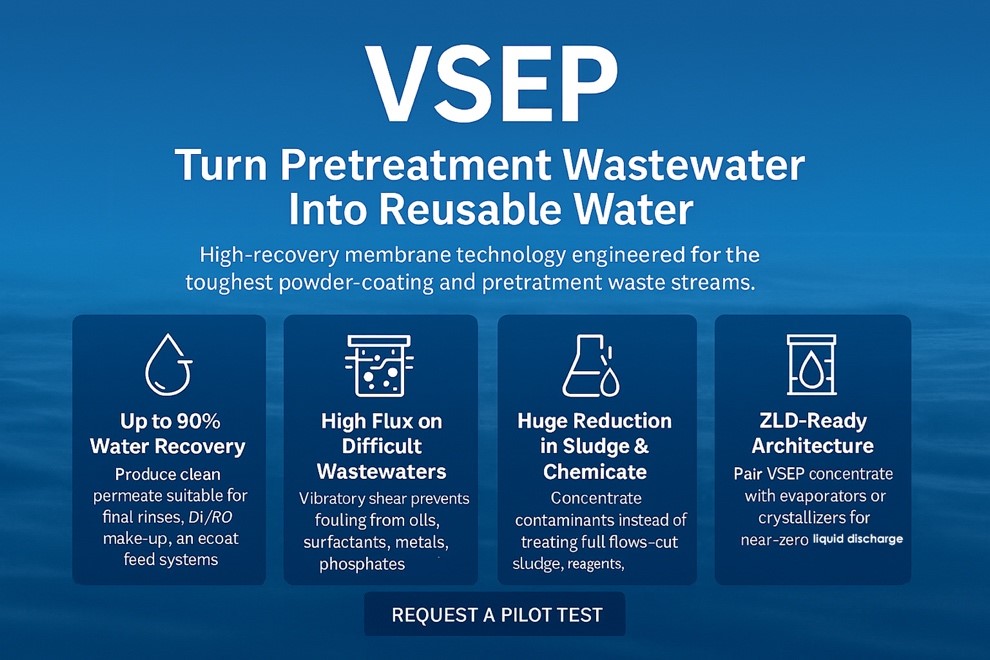
VSEP® brings a new level of performance to pretreatment and powder‑coating wastewater management by transforming what were once difficult‑to‑treat streams into reliable sources of high‑quality reusable water. Its ability to achieve up to 90% recovery means facilities can generate exceptionally pure permeate suitable for final rinses, DI/RO make‑up, or even e‑coat feedwater, significantly reducing freshwater demand. Oils, surfactants, metals, phosphates, and complexants, contaminants that typically foul or shut down conventional RO and UF systems, are kept in suspension and off the membrane surface, allowing continuous, stable operation.
For plants seeking to eliminate liquid discharge entirely, VSEP® is also ZLD‑ready. Its high-recovery, high‑strength concentrate pairs seamlessly with evaporators or crystallizers, providing an efficient path to true zero‑liquid‑discharge performance while minimizing the environmental footprint.
In short, VSEP® offers a powerful combination of water recovery, fouling resistance, process stability, and sustainability, engineered to meet the growing demands of modern surface‑finishing and powder‑coating operations.
Powder Coating: Why Plants Wash, Etch, and Convert
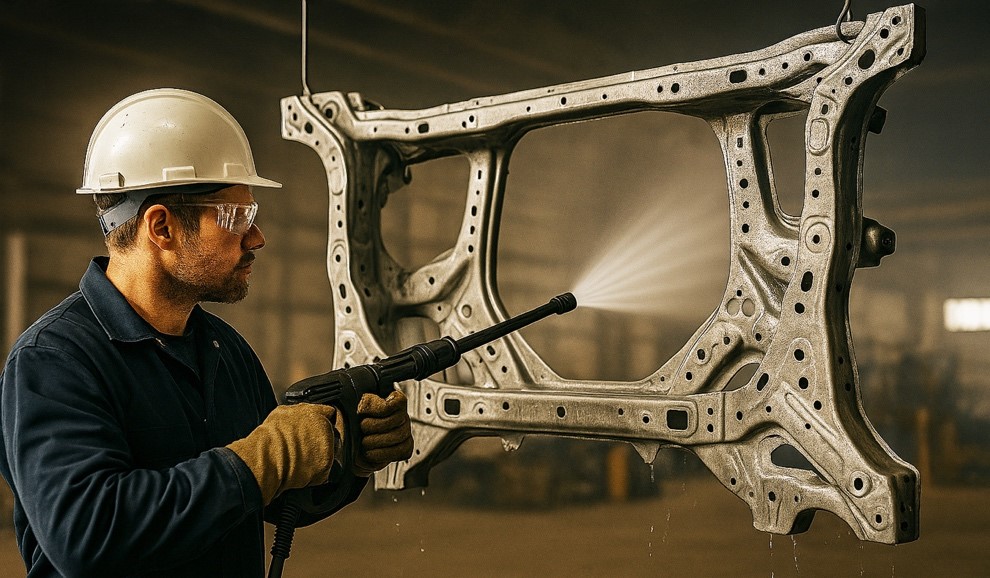
When just sandblasting alone is not enough, industrial powder coating lines rely on alkaline washing, rinsing, and conversion coatings (iron/zinc phosphate or zirconium) to ensure adhesion and corrosion resistance, especially on automotive underbodies, structural frames, and mixed‑metal assemblies. These steps clean, activate, and passivate the surface before coating, delivering durable finishes and long salt‑spray performance.
Modern pretreatment lines often include multi‑stage washers (cleaner → rinse → conversion → rinse → final DI/RO rinse) and increasingly adopt zirconium thin‑film technologies to cut sludge, energy, and phosphorus loading while meeting OEM corrosion specs.
Applications That Require Washing or Etching Before Powder Coat
Engineers specify wet pretreatment for parts exposed to harsh service or tight cosmetic requirements:
- Automotive & EV: underbodies, subframes, battery enclosures, castings, and BIW pretreatment prior to e‑coat; water quality in rinse, e‑coat, and UF loops directly affects defect rates and rework.
- Appliance, Heavy Equipment, Rail/Trailer: multi‑metal assemblies needing high adhesion and long‑term corrosion protection (iron/zinc phosphate or zirconium).
- Aluminum & Galvanized Steel: acid/neutral etch + conversion improves bonding and under‑film corrosion resistance compared with blasting alone.
Why Powder Coating Pretreatment Wastewater is Difficult
Composition varies by chemistry and stage, but commonly includes:
- Alkalinity/Acidity: carryover from cleaners, activators, and neutralizers → pH excursions.
- Phosphates: from iron/zinc phosphate conversion baths and rinses.
- Metals: Fe, Zn, Al, sometimes Ni/Cr from upstream processes or mixed operations.
- Surfactants, oils, solvents, and COD: from alkaline cleaners/degreasing and soils.
- Complexing agents (e.g., EDTA/citrate): hinder metal precipitation during treatment.
- Suspended solids/sludge: phosphate crystals, oxides, fines.
Regulatory context: Metal finishing and pretreatment operations fall under EPA Effluent Guidelines (40 CFR Part 433); facilities often require pretreatment for metals, phosphorus, pH, and toxics before discharge to sewer/POTW or surface waters.
How Facilities Typically Treat Cleaner & Rinse Effluent
Typical treatments combine equalization, pH neutralization, coagulation/flocculation, clarification, and dewatering; some facilities add UF/RO for final polishing or partial reuse, or evaporation for volume reduction/ZLD.
Pain Points Engineers Report
- High water use (pretreatment & e‑coat can exceed 50% of paint‑shop freshwater).
- Inconsistent rinse quality → coating defects, rework, and warranty risk.
- Complex waste matrix → difficult to meet limits consistently.
- Tightening discharge permits under EPA’s effluent guideline; need for reuse. [epa.gov],
- Energy & chemical cost for heating, pH control, and large‑volume treatment. [blog.powderx.com]
How VSEP® Solves Pretreatment Wastewater Challenges
VSEP® (Vibratory Shear Enhanced Processing) applies torsional vibratory shear at the membrane surface, dramatically reducing fouling by oils, surfactants, metal‑phosphate colloids, and bio‑sludge—where conventional crossflow stalls. This enables high flux at high recovery on challenging rinse waters, often without elaborate pretreatment. Unlike spiral RO membrane systems, VSEP RO does not require an ultrafiltration primary stage. VSEP RO can be applied directly to any wastewater with only 120 mesh prescreening.
Targeted Benefits for Powder Coating & E‑Coat Lines
- Closed‑Loop Rinse Recycle: VSEP RO Produces low‑conductivity permeate for final rinses or e‑coat make‑up, reducing freshwater demand. This Stabilizes FTQ/defects by maintaining consistent rinse quality.
- High‑Recovery Concentration of Phosphate/Metals: VSEP concentrates phosphate and metals for small‑volume precipitation/dewatering, slashing sludge and chemical use compared to treating the entire flow.
- Handle Complexants & Surfactants: VSEP’s shear mitigates fouling from surfactants and emulsified oils, the very species that destabilize conventional RO/UF operation in paint shops.
- Pathway to ZLD: Combine VSEP (primary concentration) + brine management (evaporator/crystallizer or vacuum distillation) for near‑100% water recovery; reuse permeate in rinses and reduce truck‑out.
- Chemistry Flexibility: Phosphate → Zirconium: As lines transition to zirconium (phosphate‑free) for environmental and maintenance benefits, VSEP helps maintain rinse recycle quality while capturing low‑sludge concentrates.
Where VSEP® Fits in the Pretreatment/Effluent Flowsheet
Option A — Rinse Water Recycle: Final rinses → VSEP‑RO/NF → Permeate to DI/RO tank → Rinse make‑up; Concentrate to small chemical precipitation + filter press, or possible ZLD options
Option B — Mixed Effluent Treatment: Mixed spent cleaner and rinses → EQ → VSEP (RO) → Permeate to non‑critical rinses or cooling water; Concentrate to existing clarifier/press → compliant discharge.
Option C — Full ZLD: Mixed spent cleaner and rinses → VSEP high‑recovery → Vacuum distillation/evaporator → DI polisher → full recirculation; salts to crystallizer. Used when sewer mandates are strict or as part of OEM sustainability goals.
Option D — VSEP after spiral: If you have an existing spiral RO system in use, VSEP can take the reject and volume reduce this even more.
Engineering Data We Use to Right‑Size Your System
When you engage VSEP, we’ll ask for:
- Flow & staging: volumes including stage‑by‑stage rinse flows, counter‑flow ratios, and dump frequencies.
- Chemistry: cleaner type, phosphate/zirconium parameters, accelerators, pH, temp, metals panel (Fe, Zn, Al, Ni, Cr), PO₄‑P, conductivity, COD/TOC, surfactants, complexants.
- Quality targets: final‑rinse conductivity/microbial control, e‑coat UF specs, discharge permit limits (40 CFR 433 context).
- Utilities/space: heat integration opportunities and existing EQ/clarifier assets to reuse.
Powder Coating Wastewater Treatment Case Study Snapshots
EV Automobile Plant Paint Shop: New Logic provided a VSEP RO filtration system to treat rinse water after metal preparation for coating. The VSEP system returns 90% of the volume as clean water for recycle leaving only 10% volume as a concentrate. The system flux rate is 15 GFD.
VSEP RO Mass Balance for EV Powder Coating Rinse Water
| Application | Rinse Water | Permeate | Reject |
| Calcium | 9.3 mg/L | 0.5 mg/L | 87.8 mg/L |
| Iron | 1.0 mg/L | ND | 9.9 mg/L |
| Magnesium | 3.4 mg/L | 0.1 mg/L | 32.0 mg/L |
| Phosphorus | 9.4 mg/L | 1.3 mg/L | 82.1 mg/L |
| Zinc | 8.8 mg/L | 0.1 mg/L | 86.4 mg/L |
| Suspended Solids | 73 mg/L | ND | 730 mg/L |
| Dissolved Solids | 635 mg/L | 58 mg/L | 5,819 mg/L |
| Hardness | 38 mg/L | 2 mg/L | 357 mg/L |
| Oil and Grease | 41 mg/L | 4 mg/L | 373 mg/L |
ND = Non-Detect

VSEP RO Powdercoat Rinse Water Samples
Typical VSEP Results for Metal Finishing Wastewater Applications
VSEP demonstration equipment has been deployed many times to treat the washwater from metal preparation prior finishing. The following table shows some of the typical results
| Application | Flux | Recovery | F Solids | C Solids |
| Metal Washwater | 60 GFD | 82.7% | 0.5% | 2.9% |
| Metal Washwater | 14 GFD | 95.7% | 1.3% | 11.8% |
| Heavy Metal Sludge | 81 GFD | 88.0% | 3.3% | 28.0% |
| Plating Wastewater | 18 GFD | 97.6% | 0.3% | 1.6% |
| Plating Wastewater | 13 GFD | 96.7% | 0.3% | 12.2% |
| Plating Wastewater | 20 GFD | 80.0% | 0.5% | 11.2% |
| Plating Wastewater | 36 GFD | 93.6% | 0.3% | 4.2% |
| Plating Wastewater | 55 GFD | 87.0% | 1.1% | 8.2% |
| Average Results | 41 GFD | 89.7% | 1.8% | 12.0% |
F Solids = Feed Solids (Effluent), C Solids = Concentrate Solids (Final reject), GFD = gallons/sq ft/day
Compliance & Sustainability
VSEP® supports regulatory compliance across a range of U.S. and international standards. This includes…
- EPA Metal Finishing Effluent Guidelines (40 CFR 433) and local POTW permits;
- Corporate water stewardship by converting once‑through rinses into closed‑loop systems, cutting CO₂ tied to water/chemical and sludge hauling.
- VSEP is regularly used for NPDES permit discharge applications
- VSEP has been named a best available technology by the EPA for several industrial effluents
VSEP Design Conditions and Limitations
- Recovery is limited by osmotic pressure (TDS concentration)
- Prescreening to <100 microns is required
- Cationic polymers and antifoam agents can reduce flux
- VSEP cannot accept aromatic solvents or free chlorine
- A 2nd stage RO polishing or DI may be needed for ultrapure water
- Membranes are limited to 55ºC and pH from 2.5 to 11.5
Get an Engineering Assessment
VSEP® Pilot Test: We’ll bench and pilot your rinse water to deliver a stage‑by‑stage mass balance, recovery & flux targets, and a CAPEX/OPEX model versus your current setup.
What you’ll receive:
- Mass balance estimate of outputs based in inputs you provide
- Operating cost estimate covering power, membrane replacement, and cleaners
- Budgetary system quotation and layout drawing
- Integration plan to protect final‑rinse and e‑coat specs (conductivity, microbiology, particles).
Schedule a consultation: info@vsep.com
Frequently Asked Questions
Is blasting alone ever enough before powder coating?
Blasting creates profile but doesn’t deliver the corrosion‑resistant conversion layer many applications require; multi‑stage pretreatment (clean → convert → rinse) is the industry norm for durability.
Will zirconium pretreatment lower my waste load?
Yes—Zr systems are phosphate‑free, often run ambient, and reduce sludge vs. zinc phosphate while maintaining adhesion/corrosion performance in many programs.
Can we really reuse final rinse water?
Yes—plants commonly use RO/DI for final rinses; integrating high‑shear membranes enables stable reuse even with surfactants/oils present.
How does VSEP handle surfactant‑rich alkaline cleaner baths?
VSEP’s torsional vibratory shear keeps surfactants, oils, emulsifiers, and cleaning agents suspended and away from the membrane surface, preventing the rapid fouling that shuts down conventional spiral RO and UF systems. In most applications, the only pretreatment required is simple prescreening to <100 microns.
Can VSEP process mixed‑metal pretreatment wastewater?
Yes. VSEP is routinely applied to mixed‑metal wastewater streams containing iron, zinc, aluminum, magnesium, and trace nickel or chromium from multi‑metal pretreatment operations. The system’s ability to handle oils, surfactants, phosphates, and metal‑organic complexes makes it well‑suited for combined rinses from steel, galvanized, and aluminum finishing lines.
What is the typical membrane cleaning protocol?
A standard VSEP system uses automated cleaning sequences tailored to the wastewater chemistry. Cleaning often involves alkaline CIP, acidic CIP, or surfactant/enzymatic cleaners depending on foulant type. The vibratory action helps expose fresh membrane surface during cleaning, resulting in shorter cleaning cycles and faster flux recovery.
What are energy requirements compared to evaporators?
VSEP consumes only a fraction of the energy required by thermal evaporators. While evaporators rely on phase‑change energy and can require 600–900 kWh per 1,000 gallons processed, VSEP typically consumes 20–30 kWh per 1,000 gallons (application dependent). Because VSEP performs the primary concentration step, it dramatically reduces the duty placed on downstream evaporators or crystallizers in ZLD systems.
Related Technical Resources
- Powder Coating Pretreatment Stacks & Stages — Multi‑stage specifications and DI/RO integration for final rinses. [blog.powderx.com]
- Wastewater Composition in Surface Coating — Metals, phosphates, surfactants, complexants, and pH variability. [almawatech.com]
- EPA Framework (40 CFR 433/438) — Applicability and limits context for metal finishing & metal products/machinery operations. [ecfr.gov], [ecfr.gov]
Get Started
If you are evaluating ways to minimize wastewater risk or reduce water consumption at powder coating or e-coat facility—or any metal finishing facility—VSEP can help.
- Request a Consultation: info@vsep.com
- View Case Studies: https://www.vsep.com/case-studies/
- Learn the Technology: https://www.vsep.com/technology/
- Read: How VSEP Treats RO Reject & High TDS Brines
As with all industrial wastewater systems, site‑specific testing is required to confirm performance under actual operating conditions. New Logic can provide bench and pilot testing for your specific project. New Logic has supplied over 450 industrial systems worldwide since 1987.