
Stripped Sour Water Treatment for Refineries
Selenium Removal from Sour Water Stripper Effluent Using VSEP™ RO
What Is Sour Water in Refinery Operations?
Sour water is a sulfur‑ and ammonia‑containing wastewater generated during crude oil refining and hydrotreating operations. During hydrotreating, hydrogen gas is introduced under elevated temperature and pressure to convert sulfur and nitrogen compounds in crude oil into hydrogen sulfide (H₂S) and ammonia (NH₃). Stripped Sour Water Treatment is critical.
As crude is hydrotreated, wastewater is generated from:
- Moisture in the crude oil feed
- Steam injection
- Reactor quench water
- Condensed process vapors
When hydrogen sulfide and ammonia dissolve into this water, the resulting wastewater is classified as sour water. Heavy crude oils typically contain higher sulfur levels and generate larger sour water volumes with increased contaminant loading.
In addition to sulfides, sour water may contain:
- Ammonia
- Phenols
- Selenium
- Dissolved metals and trace organics
How Hydrotreating Generates Sour Water
Hydrotreating is a critical refining step used to meet finished fuel sulfur specifications and protect downstream catalysts. In this process:
- Sulfur compounds are converted to hydrogen sulfide (H₂S)
- Nitrogen compounds are converted to ammonia (NH₃)
These compounds become dissolved in condensed process water as the reactor effluent is cooled and separated. The aqueous phase collected in downstream separators forms the refinery’s sour water stream, which must be treated prior to discharge.
What Is Stripped Sour Water?
Sour water is treated in a Sour Water Stripper (SWS) to remove hydrogen sulfide and ammonia before discharge to a wastewater treatment system.
In the stripping process:
- Sour water enters the top of a vertical stripping tower
- Steam is injected at the bottom
- As steam and water flow counter currently, volatile compounds are transferred into the vapor phase
Hydrogen sulfide and ammonia are removed overhead and routed to acid gas handling systems or sulfur recovery units. The treated effluent exiting the bottom of the tower is referred to as stripped sour water.
For most refineries processing conventional crude, stripped sour water does not present downstream treatment issues. However, refineries processing heavy crude or opportunity crudes often experience elevated concentrations of selenium.
Why Selenium Is a Problem in Stripped Sour Water
Selenium is chemically similar to sulfur and frequently occurs alongside it in crude oil—especially in heavier crudes such as Venezuelan crude. While sulfur compounds can be effectively removed by steam stripping, selenium remains dissolved in stripped sour water.
Unlike hydrogen sulfide, selenium:
- Is non‑volatile
- Cannot be removed by sour water stripping
- Passes through conventional wastewater treatment systems
The U.S. EPA regulates selenium discharge due to concerns over bioaccumulation in aquatic ecosystems and waterfowl. Elevated selenium in stripped sour water often requires advanced treatment to meet regulatory limits prior to discharge or reuse.
Treatment Options for Stripped Sour Water
Limitations of Conventional Treatment Methods
Traditional selenium treatment approaches such as chemical precipitation and co‑precipitation can be costly and operationally complex. These methods often result in:
- High chemical consumption
- Increased sludge generation
- Treated water suitable only for discharge, not reuse
Adsorptive media and conventional membrane systems are frequently impractical due to fouling, scaling, and suspended solids associated with stripped sour water effluent.
Membrane Treatment Using VSEP™ RO Technology
Membrane systems are highly effective at removing dissolved solids, including selenium. However, conventional spiral‑wound RO membranes are typically unsuitable for stripped sour water due to fouling and scaling risks.
The VSEP™ (Vibratory Shear Enhanced Process) RO system overcomes these limitations and has been successfully installed at a major U.S. refinery for stripped sour water treatment.
Key VSEP advantages include:
- Wide membrane feed channels allowing suspended solids passage
- High‑frequency membrane vibration (≈50 Hz)
- Shear waves at the membrane surface that resist fouling and scaling
- Stable, high‑flux operation with reduced cleaning frequency
These features enable efficient selenium removal from difficult refinery wastewater streams.
VSEP Performance for Selenium Removal
The following pilot trial data demonstrates contaminant reduction achieved using a two‑stage membrane configuration: VSEP RO as the primary separation step, followed by spiral RO polishing.
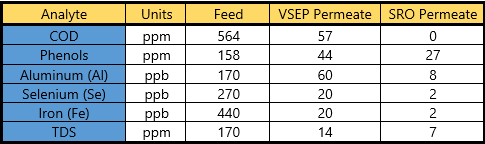
Typical VSEP flux rates for stripped sour water are 30 GFD (≈50 LMH). Depending on feed concentration and discharge limits, a multi‑stage RO system can consistently achieve very low selenium levels in the final effluent.
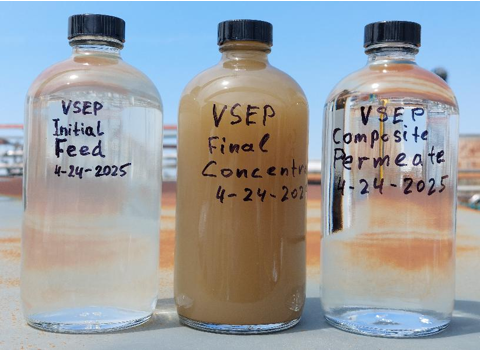
Samples Taken During a VSEP Trial
Reuse and Zero Liquid Discharge Applications
Unlike chemical treatment methods, VSEP RO produces a high‑quality permeate suitable for reuse. Treated water may be reused as:
- Boiler feedwater
- Cooling tower makeup
- Process reuse water
Typically, a VSEP system can recover up to 98% of the feed volume as reusable permeate, leaving approximately 2% concentrated residual, which can be evaporated to achieve a Zero Liquid Discharge (ZLD) solution.
Pilot Testing and Performance Projections
New Logic offers pilot testing—including full‑scale demonstrations—to evaluate stripped sour water treatment performance for specific refinery crude slates.
Pilot testing allows:
- Verification of selenium removal performance
- Measurement of flux, recovery, and fouling behavior
- Accurate operating cost projections
- Optimization for reuse or ZLD configurations
Request a No‑Cost Performance Projection
To receive a no‑cost performance projection and budgetary cost estimate for stripped sour water treatment, contact:
Complete Case Study:
https://www.vsep.com/articles/stripped-sour-water-treatment-with-vsep/