
Calcium Carbonate Production, Dewatering, and VSEP® Ultrafiltration Technology
High‑Efficiency PCC Dewatering with VSEP® Ultrafiltration
VSEP ultrafiltration dewaters PCC by using high‑frequency vibratory shear to prevent fouling while forcing water through a UF membrane, producing crystal‑clear permeate and a high‑solids PCC concentrate. Unlike filter presses or vacuum filters, VSEP calcium carbonate filtration retains virtually 100% of sub‑micron particles and consistently achieves 50–70% solids before drying.
Engineers worldwide rely on VSEP’s vibratory shear ultrafiltration to solve the most persistent challenges in PCC (Precipitated Calcium Carbonate) production, including fine‑particle retention, high‑solids concentration, and continuous dewatering performance. VSEP delivers a stable flux with sub‑micron PCC and a major reduction in downstream drying energy and process bottlenecks. Designed for modern calcium carbonate plants, VSEP replaces traditional filter presses, vacuum belt filters, and centrifuges with a compact, continuous, low‑maintenance solution engineered for industrial reliability.
Speak with an experienced VSEP Engineer: info@vsep.com
Overview of the Global Calcium Carbonate Industry
Calcium carbonate is a major industrial mineral used in paper production, paint and coatings, plastics, sealants, and pharmaceuticals. The global calcium carbonate market is $65 billion and projected to reach $94 billion within ten years, driven by demand for high‑brightness fillers and engineered particle sizes.
PCC Production by Country
Precipitated Calcium Carbonate (PCC) is produced synthetically to achieve controlled particle size, morphology, and brightness. Global PCC production totals ~18 million tons per year, dominated by Asia.
Top PCC‑Producing Countries
| Rank | Country | PCC Production / Year |
| 1 | China | ≈ 11.5 million tons |
| 2 | United States | ≈ 2.84 million tons |
| 3 | Germany | ≈ 0.6–0.7 million tons |
| 4 | France | ≈ 0.6 million tons |
| 5 | Spain | ≈ 0.5–0.6 million tons |
China controls 63.9% of global PCC capacity, making it the dominant global producer.
PCC Manufacturing Process – Two form of calcium carbonate are used industrially:
Ground Calcium Carbonate (GCC)
- Natural limestone or marble is crushed and ground.
- Produces irregular particle shapes with lower brightness.
- Low energy requirement.
Precipitated Calcium Carbonate (PCC) – PCC is produced through a controlled chemical process:
- Calcination: CaCO₃ → CaO (quicklime) + CO₂
- Slaking: CaO + H₂O → Ca(OH)₂ (slaked lime)
- Carbonation: Ca(OH)₂ + CO₂ → CaCO₃
This process deconstructs calcium carbonate in its raw form and then reassembles it in a very controlled way. This reaction forms high‑brightness, uniform particle‑size PCC.
PCC Washing and Thickening – After precipitation, PCC slurry is normally:
- Thickened via gravity thickeners to 15–35% solids
- Washed using: Belt wash filters, filter presses, counter‑current decantation (CCD)
Washing removes dissolved salts, unreacted lime, and impurities. After this washing step, the solids must be dewatered prior to drying.
Conventional Dewatering Methods and Their Limitations
Filter Presses
- Achieves up to ~70% solids with membrane squeeze.
- Long batch cycles (1–4 hours).
- Fine PCC particles pass through cloths, causing solids loss.
- High maintenance: cloth changes, plate alignment, hydraulics.
- Large footprint.
Vacuum Belt and Drum Filters
- Produce 25–45% solids.
- Lower overall solids due to PCC’s fine particle size.
- Fines bypass into filtrate.
- Require large vacuum systems and significant floor space.
Decanter Centrifuges
- Produce 40–55% solids.
- Limited efficiency with soft, sub‑micron PCC.
- High energy consumption and wear on mechanical components.
Dewatering Challenges After PCC Washing – PCC exiting the wash stage typically consists of:
- 10–25% solids
- 0.03–1 µm particles (high surface area)
- Soft, compressible solids that resist forming rigid filter cakes
These characteristics make traditional dewatering equipment inefficient, maintenance‑heavy, or incapable of retaining the finest particles.
VSEP Ultrafiltration for Final PCC Dewatering
How VSEP Ultrafiltration Works
VSEP (Vibratory Shear Enhanced Processing) uses an ultrafiltration membrane that oscillates 50 times per second with a peak to peak displacement of ½”, creating intense vibratory shear instead of crossflow velocity used in conventional membrane systems.
Mechanism
- Intense shear prevents particle buildup at the membrane surface.
- PCC solids remain in full suspension; no cake layer forms.
- Flux remains stable even with sub‑micron particles.
- Membranes act as true molecular barriers, retaining solids.
This behavior is fundamentally different from:
- Dead‑end filtration
- Cross‑flow systems
- Cloth‑based filters
- Vacuum dewatering equipment

Why VSEP Retains Virtually 100% of PCC Solids
Membrane Pore Size
UF/NF membranes exclude all particles larger than their nominal cutoff.
PCC particles (30 nm–1 µm) are much larger than the membrane pore structure.
Shear‑Driven Anti‑Fouling
- Vibratory shear removes accumulated solids.
- Prevents permeability decline.
- Eliminates the compressible cake problem.
True Barrier Separation – Unlike filter cloth:
- No weave deformation
- No needle holes or early‑cycle filtrate spikes
- No bypass pathways
Permeate clarity routinely reaches less than 0.2 NTU, suitable for reuse in slaking or carbonation.
VSEP as a Final Dewatering Step After PCC Washing
Performance
| Stream | Result |
| Permeate | Crystal‑clear water, free of solids, reusable in process |
| Concentrate | 50–70% solids PCC slurry, pumpable and ready for drying |
Why VSEP Reaches 50–70% Solids
- Water removal occurs through the membrane, not cake drying.
- No settling limitations.
- High shear maintains homogeneity.
- No air‑drying or mechanical squeezing required.
Process Advantages of VSEP
- A) Zero Solids Loss
- Practically 100% solids retention
- Eliminates fines carryover
- Reduces load on downstream water treatment
- B) Continuous Operation
- Unlike batch filter presses
- Simplifies scheduling and reduces operational interruptions
- C) Reduced Footprint – One VSEP module can replace:
- Multiple filter presses
- A vacuum drum or belt filter
- In some cases, a gravity thickener
- D) Reduced Operating Costs
- No filter cloths
- No vacuum systems
- Lower maintenance and labor
- Lower wear compared to centrifuges
Why VSEP® Outperforms Conventional Filtration in CaCO3 Plants
- Eliminates chronic filter blinding with patented vibratory shear
- Effectively handles sub‑micron particles with virtually 100% capture
- Achieves higher solids concentration (up to 70%)
- Reduces wash water use and operating cost
- Delivers clean permeate for recycling
- Recovers product otherwise lost from washdown
How We Validate Performance
- Bench-scale testing
- Onsite pilot testing (7-30 days is typical)
- Parameters measured: flux, temperature, pressure, rejection rates, recovery rate
- Deliverables: projection reports, membrane selection, pretreatment design
For PCC producers seeking reliable, high‑solids dewatering with minimal maintenance, VSEP provides a technically robust alternative to filter presses, vacuum belts, and centrifuges. Every project is unique and New Logic will tailor a system design to meet your plant’s processing needs.
Case Study #1 – Alabama Carbonates – 1995
A VSEP 36” system was installed to treat wash water stored in a pond to recover product. The VSEP used a PVDF 200 kDa ultrafiltration membrane operating at 70ºC and 55 psi. The 500 square foot filter produced 6.9 GPM of UF permeate and this filter operated continuously for 11 years before replacement was needed. The VSEP system concentrated the initial solids from 6.7% to 68.0%
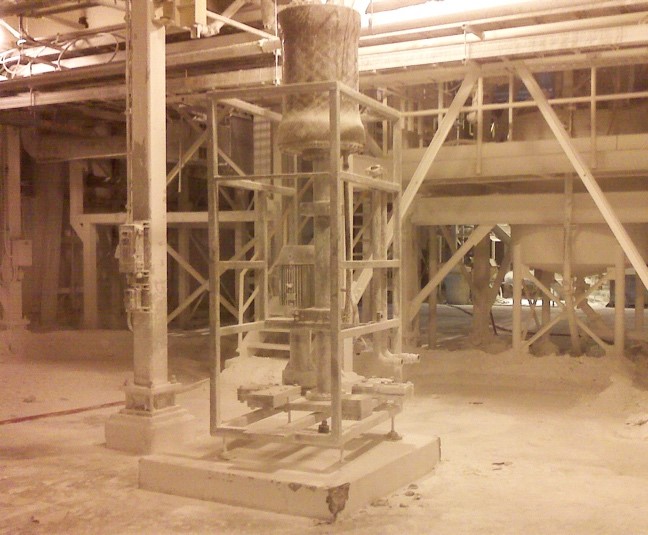
Alabama Carbonates VSEP Dewatering System
Case Study #2 – Omya Vermont – 1996
A 36” VSEP was used to complete final dewatering after washing the product. The system concentrated solids from 28% to 67% with an average flux rate of 49 GFD (gallons per square foot per day). In this case a 500 Da nanofiltration membrane was used
Case Study #3 – Steep Rock Resources – 1998
A PES 100 kDa UF membrane was commissioned to filter calcium carbonate slurry prior to drying. The initial feed solids are 20% and the final concentrate sent to drying is 74%. The system processed 9 dry-tons/day.
Below is a concise, engineering‑focused “Limitations” section for your VSEP landing page.
It maintains a technical tone and lists realistic operational boundaries without sounding like marketing.
No citations are included because you provided the constraints directly and the page is not intended as a sourced research document.
Design Limitations of VSEP®
While VSEP provides high‑efficiency dewatering for fine PCC slurries, certain operating constraints must be considered during system design and integration:
1. Feed Screening Requirement – Feed slurry should be screened to <100 microns before entering the VSEP module. Larger particles, agglomerates, or debris can cause localized membrane abrasion, or premature seal wear.
2. Maximum Operating Temperature – Standard membrane modules have a maximum operating temperature of approximately 90°C.
3. Sensitivity to Polymer Additives – Certain organic or high‑molecular‑weight polymers (e.g., flocculants, dispersants, rheology modifiers) can reduce achievable flux and increase fouling rate. Pretreatment review is recommended if polymers are used upstream.
4. pH Operating Window Depends on Membrane Type – UF, NF, and RO membranes each have different allowable pH ranges, typically: UF/NF: ~pH 2–12 (depending on material), RO: narrower ranges unless chemically hardened
5. Viscosity Constraints at High Solids
- As PCC approaches 50–60% solids, slurry viscosity increases significantly. High viscosity can:
- Limit concentrate flow rate
- Increase pump horsepower
- Reduce system recovery
- Temperature and shear help mitigate this, but viscosity remains an inherent boundary condition.
6. Shear‑Sensitive Slurries – VSEP’s high‑frequency shear is beneficial for PCC, but not suitable for shear‑sensitive biological or polymer‑rich fluids where particle breakup is undesirable.
Pilot Testing and Performance Projections
New Logic offers pilot testing, including full‑scale demonstrations, to evaluate wastewater treatment performance for specific projects. In-house bench testing is also available. Pilot testing is required to validate full-scale system design. Pilot testing is supervised by membrane engineers with decades of experience. Pilot testing allows:
- Verification of filtrate quality
- Measurement of flux, recovery, and fouling behavior
- Accurate operating cost projections
- Optimization for reuse or ZLD configurations
Get a Site‑Specific Cost Analysis
System performance depends on solids loading and target recovery rates. Every facility is different. Actual performance and system design depends on:
- Slurry chemistry
- Recovery target
- Starting solids concentration
- Type of membrane targeted
For a performance projection for your specific project, contact a VSEP engineer: info@vsep.com
Learn more:
- Study membrane types: https://www.vsep.com/technology/membrane-technology/
- Review VSEP® Technology: https://www.vsep.com/technology/
- Explore Pilot Testing Options: https://www.vsep.com/technology/pilot-testing/
Patented VSEP® is manufactured in Nevada USA by New Logic Research since 1987 and is used globally for industrial applications, including mining, landfills, pigment dewatering, acid purification, food processing, and PFAS‑impacted streams. VSEP is widely used in permit-driven discharge applications.

This page was reviewed by New Logic’s senior engineering staff and updated February 2026.